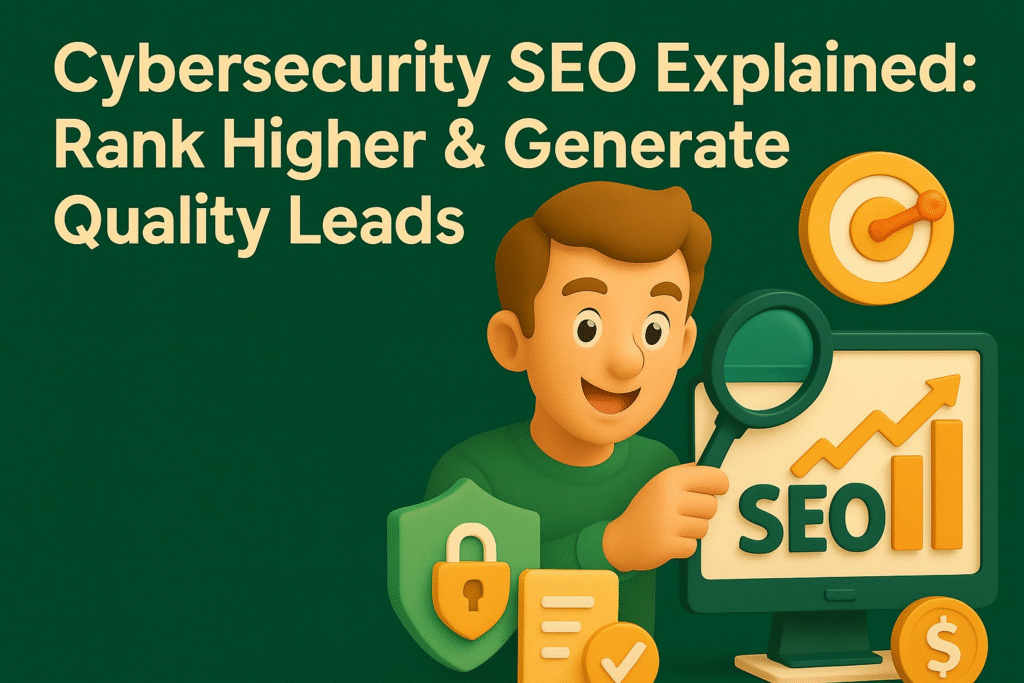
In the ever-changing landscape of cybersecurity, having visibility is crucial—it’s everything. No matter how cutting-edge your solutions may be, if potential clients can’t find you online, you’re already at a disadvantage. That’s where cybersecurity SEO becomes your strongest digital asset.
Today’s IT buyers and CISOs are actively researching, comparing, and narrowing down their vendor options through search engines. If your brand isn’t showing up on the first page, it’s essentially invisible—and easily forgotten. However, with a well-crafted SEO strategy specifically designed for cybersecurity, you can cut through the noise, attract high-intent traffic, and convert leads effectively.
This article explores the precise tactics that successful cybersecurity companies employ to thrive online: from AI-driven SEO and technical optimization to real-world case studies and expert content that fosters trust. Whether you’re a startup or a well-established enterprise, this guide will serve as your roadmap to dominate the search engine results pages (SERPs) and accelerate your growth.
Cybersecurity SEO Fundamentals:
Cybersecurity SEO stands apart from general SEO because it caters to a more technically proficient audience—CISOs, security engineers, compliance leaders—who often conduct thorough research. The buying process can involve as many as 11 stakeholders per deal, making it essential to create content that addresses various levels of intent—from simple questions to in-depth technical analyses.
Looking to understand how SEO tactics shift across different industries? See how we tailor strategies in this guide on SEO for moving companies to learn about niche-specific optimization approaches. This highlights the importance of not just ranking on SERPs, but also having a strong presence through featured snippets, answer engine optimization (AEO), geographic optimization (GEO), and other answer engine appearances.
Why SEO Matters for Cybersecurity Firms:
Building Authority & Trust: For cybersecurity companies, it’s essential to demonstrate E‑E‑A‑T—experience, expertise, authoritativeness, and trustworthiness—by creating detailed and accurate content.
Generating Leads & Building a Pipeline: Content driven by SEO often brings in high-quality leads, which can lead to a robust pipeline and impressive ROI over time.
Focusing on Targeted Intent: Rather than competing for popular head keywords like “endpoint security,” firms can attract traffic through long-tail and question-based searches, such as “SIEM comparison for mid-market.”
Proven SEO Strategies for Cybersecurity
Address the Entire Buyer Journey: Tailor your content to each stage of the decision-making process—from awareness (like “what is ransomware”) to evaluation (“SIEM vs EDR”) and finally to conversion (product pages, demos, and interactive trials). Encourage potential customers to engage with demos, gated PDFs, and ROI calculators as part of your product-led SEO strategy
Thorough Keyword Research
Utilize tools such as Google Keyword Planner, Search Console, Keyword Surfer, Moz Explorer, and SEMrush to discover long-tail keywords and niche opportunities. Data from 2025 indicates that head terms average only about 150 searches per month, while grouped long-tail terms can drive cumulative traffic with less competition.
Technical SEO & Site Security
Essential elements include HTTPS with a valid SSL certificate, mobile-first responsive design, strong Core Web Vitals, a crawlable site architecture, and FAQ/schema markup. Cybersecurity auditors understand that secure, fast, and crawlable websites enhance both rankings and trust.
Creating Expert Content
Involve your technical team—researchers and engineers—to produce content that genuinely resonates with their peers. A technical voice fosters credibility and trust among cybersecurity professionals. Don’t forget to include case studies, incident reports, and documented frameworks.
Content Clusters and Topic Authority
Let’s talk about Content Clusters and Topic Authority. Start by creating pillar pages around essential themes like “ransomware protection” or “zero trust architecture,” and back them up with in-depth cluster posts. This approach not only enhances semantic relevance but also establishes your topical authority, which can help improve your rankings over time.
Strategic Link Building
Now, onto Strategic Link Building. It’s crucial to secure backlinks from reputable cybersecurity sources such as CSO Online and Dark Reading, as well as from industry forums and conferences. These high-quality, niche-specific links are a strong indicator of trust and domain authority.
Finally, when it comes to Measuring ROI and KPIs, don’t just focus on rankings. Keep an eye on impressions, click-through rates, demo or trial sign-ups, form submissions, and how they contribute to your pipeline. SEO can significantly impact your ROI—on average, firms that take it seriously see about $1.7 million a year in new revenue.
Integrating AI and Geo Strategies:
As the world of search continues to change, relying solely on traditional SEO just won’t cut it anymore. It’s essential to weave in AI SEO, Answer Engine Optimization (AEO), and Generative Engine Optimization (GEO) into your approach to keep your visibility and credibility intact in this AI-driven era.
The Shift Toward AI-Driven Search
Did you know that zero-click searches now make up about 58–60% of search journeys in the U.S. and Europe? This means that users are often getting their answers without even clicking on any websites.
AI Overviews, which are Google’s AI-generated summaries, show up in nearly 47% of search results, particularly for queries that require problem-solving. This has led to significant drops in organic traffic for some sites, with declines ranging from 18% to a staggering 64%. SaaS SEO Agency
Benefits of AI Adoption in SEO
A solid 65–68% of businesses have reported better SEO performance and improved content ROI after they started using AI-driven strategies.
Websites that incorporate AI into their SEO strategies often experience up to 70% more organic traffic, quicker keyword insights, enhanced content quality, and conversion rate boosts of up to 14.6%, compared to just 1.7% with traditional SEO.
Today, around 61–86% of SEO professionals and marketers are utilizing AI tools in their workflows, whether it’s for keyword research, technical audits, or optimization.
ChatGPT & AI Assistants: A New Referral Source
ChatGPT has now surpassed Bing in sending referral traffic, with a remarkable 60% increase in traffic over just a few months and a staggering 145× growth in referral reach since mid-2023.
In some companies, AI-driven search referrals have already boosted conversions by over 9%, highlighting how conversational engines are becoming trusted sources for leads.
Strategic Execution
Optimize for Featured Snippets & PAA – With nearly 60% of searches ending without any clicks, capturing snippets and entries in the People Also Ask section is crucial for maintaining visibility in zero-click scenarios.
Build Structured Content – Implement schema markup, FAQ sections, comparison tables, and how-to guides to provide AI models with easily accessible information.
Align for Citational Authority – Following GEO best practices ensures that AI systems can confidently cite your content, especially in summary formats.
Track AI-specific traffic – Keep an eye on traffic coming from platforms like ChatGPT, Perplexity, and others—not just Google through Search Console.
Use AI-SEO tools – Tools like Athena, Profound, and Scrunch AI assist brands in understanding how AI systems discover and represent them, helping to fine-tune content for better AI visibility.
Detect AI-generated content and transform it into something that feels more human with our AI Content Detector. Just paste your text, and you’ll get accurate, relatable results in no time!
Summary Table: Why AI / AEO / GEO Matters
| Metric / Trend | Statistic / Insight |
| Zero-click searches | ~58–60% of queries now yield no clicks |
| AI Overviews prevalence | Up to 47% of Google results, esp. for complex queries |
| Traffic declines reported | 18–64% losses in organic visits due to AI features |
| Business SEO improvements | 65–68% report better performance with AI strategies |
| Organic traffic boost with AI | Up to 70% increase for sites using AI-driven SEO tools |
| Conversion uplift | AI-optimized sites see up to 14.6% conversion rates |
| Professional AI adoption | 61–86% of SEO pros use AI tools now |
| ChatGPT referral growth | 145× traffic increase since mid‑2023; surpasses Bing |
| AEO / GEO impact projections | Brands reliant on traditional SEO may lose 20–40% CTR by 2026 |
Key Insights from These Case Studies
- Traffic growth varied significantly, ranging from 64% in just 5 months to an impressive 167% in 8 months, and even hitting 236% in 6 months when content and SEO strategies are in sync.
- Lead generation saw notable improvements: for instance, 111% more marketing-qualified leads, 53% more gated conversions, and a threefold increase in lead capture through timely news content.
- Expanding the keyword portfolio and achieving first-page rankings brought in quality traffic—like hundreds of new keyword rankings for Castra.
- Link building, especially with niche-relevant and authoritative sources, contributed to about 80% of success in certain cases.
- Speed is crucial: real-time content on breaches (like what GrackerAI offers) led to quick spikes in visibility and engagement.
Takeaways for Cybersecurity SEO Strategy
- Kick off your strategy with a thorough technical SEO audit to tackle issues like sluggish page speeds, faulty redirects, or canonical errors right from the start.
- Make pillar-content frameworks your priority, and support them with long-tail blog clusters that align with user intent.
- Bring your content to life with real-world storytelling: think case studies, incident response tales, and threat analysis blog posts — these not only resonate but also help establish your authority.
- Don’t overlook news-jacking tactics: creating timely content around the latest threat news or exploit disclosures can give you a quick boost in visibility.
- Aim for high-quality backlinks from reputable cybersecurity domains, publications, and trusted forums.
How to Choose a Cybersecurity SEO Agency or Services Provider
When you’re on the hunt for a cybersecurity SEO agency or services, keep these priorities in mind:
- Industry knowledge: They should really get CISOs, compliance, incident response, and the technical lingo of your audience.
- Technical SEO capability: Look for strong auditing skills, site performance expertise, schema markup knowledge, and mobile optimization.
- Content excellence: They need to produce authoritative, accurate content that’s backed by domain experts.
- Measurement mindset: Focus on the quality of leads and the sales pipeline, not just on rankings.
- Strategic alignment: They should offer a mix of SEO, AEO/GEO, and seamlessly integrate with PPC or conversion optimization.
There are top agencies out there that specialize in serving cybersecurity firms; Compare flexible plans designed for startups and enterprise teams on our pricing page.
Tactical Execution Checklist
| Area | Key Actions |
| Keyword Strategy | Identify long‑tail and question‑based terms (e.g. “SIEM comparison 2025”) |
| Technical SEO | Fix page speed, mobile responsiveness, HTTPS, schema FAQ, crawlability |
| Content Development | Publish expert-led pillar pages, cluster posts, case studies, whitepapers |
| Backlinks | Outreach to cybersecurity publishers, forums, industry events |
| AI SEO / GEO | Use structured data, FAQ markup, conversational Q&A, metadata for citation |
| Analytics | Monitor impressions, clicks, conversions, pipeline, CTR, bounce rate |
Recommended Tools
- Use SEMrush or Ahrefs for insights on competitive keywords and backlinks.
- Leverage Google Search Console, Keyword Planner, and Google Trends for free keyword tracking and site health information.
- Utilize Screaming Frog SEO Spider for technical audits and crawl diagnostics—it’s especially useful for identifying mixed content or broken links that could undermine security trust.
Common Mistakes to Avoid
- Over-optimizing generic head terms without a niche focus can lead to missing out on valuable long-tail traffic.
- Neglecting technical SEO issues like slow Core Web Vitals or broken schema can hurt your site’s performance.
- Publishing shallow content without proper technical attribution or expertise is a big no-no.
- Focusing only on rankings instead of measuring ROI and pipeline impact can mislead your strategy.
- Ignoring AEO/GEO optimizations in today’s AI-driven search landscape is a mistake you can’t afford to make.
Why Cybersecurity Companies Should Prioritize SEO Now
As buyers increasingly conduct their own research and click-through rates drop, having visibility through optimized content and structured answers is crucial. With the cybersecurity market being so vast and the financial benefits of SEO-generated leads being significant, any company that overlooks seo for cybersecurity in this space risks losing ground in a competitive environment
What is cybersecurity SEO?
It’s a specialized SEO strategy crafted just for cybersecurity companies, focusing on technical content, building trust, and targeting the right experts to connect with decision-makers in the tech field.
How is SEO for cybersecurity companies different from regular SEO?
This approach is tailored for a tech-savvy audience, requiring a secure website setup, in-depth authoritative content, and precise keyword targeting.
When should I hire a cybersecurity SEO agency?
Consider hiring one if you need a strategy that’s specific to your industry, want quicker results, require content from domain experts, and prefer metrics that align with your sales pipeline instead of just traffic numbers.
What do cybersecurity SEO services typically include?
These services usually encompass keyword research, technical audits, expert content creation, link building, AEO/GEO optimization, analytics, and conversion tracking.
What role does AI play in cybersecurity SEO?
AI-driven SEO, AEO, and GEO ensure that your content is not only ranked traditionally but also referenced by generative AI systems, enhancing visibility as search technology evolves.
Conclusion
To succeed in the competitive and trust-centric cybersecurity landscape, mastering cybersecurity SEO is essential—it’s a strategic necessity. By integrating technical site optimization, expert-driven content, targeted keyword strategies, ethical link-building, and modern AI-aware search techniques (AEO and GEO), cybersecurity brands can enhance their visibility and authority. The outcome? Quality leads, a sustainable pipeline, and a solid competitive advantage. Whether you’re looking for SEO for cybersecurity companies, a dedicated cybersecurity SEO agency, or comprehensive cybersecurity SEO services, make sure your strategy resonates with your audience, measures real business results, and upholds both technical and editorial excellence. That’s the way to rank—and thrive—in the cybersecurity arena.
Explore our homepage to see how we help brands like yours stand out in competitive search landscapes.
Compare flexible SEO plans tailored to cybersecurity firms on our pricing page—transparent, scalable, and designed for measurable ROI.