
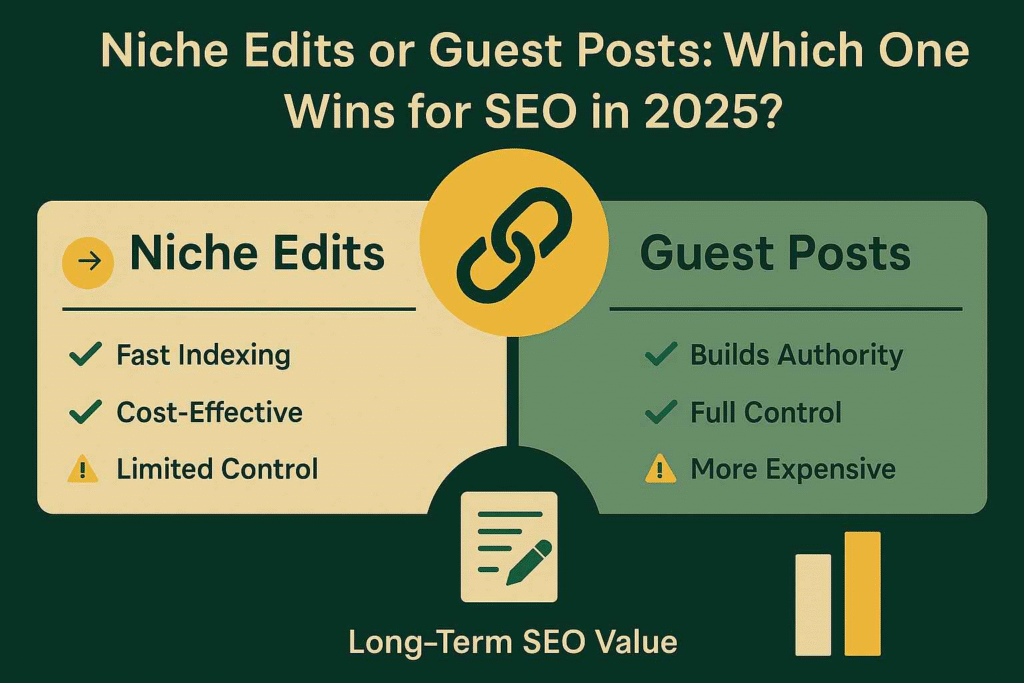
Niche Edits vs Guest Posts—it’s the kind of question SEOs will still be arguing about over coffee in 2025. And for good reason: your link-building choices can seriously influence your rankings, especially with Google’s SpamBrain AI working overtime to sniff out link spam.
Both tactics are trusted and widely used. But they serve different purposes—and they come with their own pros, cons, and price tags. Whether you’re looking for quick wins or building long-term authority, knowing when and how to use each one is key.
In this article, you’ll learn:
- What niche edits and guest posts actually are
- How they stack up in terms of control, cost, and value
- When each strategy makes sense
- What top SEO experts recommend right now
Understanding how niche edits work is essential before weighing Niche Edits vs Guest Posts for your SEO strategy.
What Are Niche Edits in SEO? 🔄
A niche edit (also called a link insertion) is when you add your backlink into an already published article. The key? You don’t create new content—you find a live page that’s already indexed and insert your link where it fits naturally.
Let’s say there’s an article about SEO tools, and your tool is relevant to the discussion. You place your backlink right in that context. Because the page is already up, Google can crawl and recognize the link fast.
This technique is gaining popularity among advanced link builders, especially when combined with high-authority domains. As explained in Search Engine Journal’s link-building strategies, contextual relevance plays a major role in how Google evaluates inserted backlinks.
✅ Why People Use Niche Edits
1. Fast Indexing
Your link goes live on a page Google already knows. That means it starts passing value in just a few days—typically between 2–7.
2. Cost-Effective
No content creation means lower costs.
- Standard links: $50–$300
- High-authority placements: $400–$600+
3. Immediate Boosts
Perfect for giving underperforming pages a lift, especially when you’re targeting exact-match or contextual anchors.
⚠️ The Downsides
Limited Control
You’re working with someone else’s content. That means you might need to tweak your anchor text to fit the surrounding copy.
Risk of Low-Quality Sites
Some providers insert links into irrelevant or spammy sites. That’s a problem—especially after Google’s 2024 Link Spam Update, which penalized over 12% of domains using non-contextual link insertions (Semrush Webspam Report).
Not Your Content = Not Your Rules
If the original publisher updates or deletes the content, your link could vanish or lose value.
How Do Niche Edits Work Step-by-Step?
Here’s how the process usually looks:
- 🔍 Find older but relevant articles in your niche
- ✉️ Reach out to the webmaster/editor—or buy the placement
- 🖊️ Ask for a link to be inserted with your chosen anchor
- ✅ Ensure it blends in naturally
There are two main types:
| Type | Description | Control | Risk |
| White-Hat | Manual outreach with editorial vetting | Medium | Low |
| Grey-Hat | Paid insertions without oversight | Low | Medium–High |
👉 If you’re in it for the long game, white-hat is the safer route. Use grey-hat sparingly, and never on your money pages.
What Is Guest Posting in SEO? 📝
Guest posting is all about writing and publishing original content on someone else’s blog—with your backlink naturally included. It’s an old-school tactic that still delivers serious results.
In 2025, guest posting remains a top strategy—especially for businesses trying to build authority in competitive spaces or industries where EEAT signals matter (think health, finance, SaaS).
✅ Advantages of Guest Posting
1. Full Control Over the Message
You decide the topic, write the piece, and control the anchor placement. That alignment between content and link? Priceless.
2. Builds Authority and Brand Trust
With a byline or author box, you boost your visibility and tick all the EEAT boxes (Expertise, Authoritativeness, Trust).
3. Stronger Link Value
According to Ahrefs (2024), guest posts on DR60+ sites pass about 28% more link equity than niche edits.
4. Real Audience Exposure
A well-placed guest post can bring referral traffic, improve time on page, and reduce bounce rates.
These advantages highlight why many marketers still lean toward guest posts in the Niche Edits vs Guest Posts conversation.
⚠️Challenges of Guest Posting
Time-Consuming
You’ll need to pitch topics, go back and forth with editors, write fresh content, and polish it to fit their standards.
More Expensive
- Basic cost: $150–$800 per post
- Top-tier sites: Can go beyond that
It Has to Be Relevant
Your guest post needs to match the host blog’s audience. Otherwise, it won’t drive results—or get approved.
How Do Guest Posts Work Step-by-Step?
This step-by-step process highlights how guest posting works and adds context to the broader Niche Edits vs Guest Posts debate
- 🔍 Research relevant, high-authority blogs
- ✉️ Pitch your topic ideas to the editor
- 🖊️ Create valuable, original content
- ✅ Add your backlink naturally into the article
- 📤 Submit with your name, bio, and sometimes a photo
👉 Personalized outreach is everything. According to BuzzStream (2024), personalized pitches get 53% more responses than cookie-cutter templates.
Niche Edits vs Guest Posts: A Side-by-Side Breakdown 📊
This side-by-side breakdown clarifies where Niche Edits vs Guest Posts differ most in terms of value and execution.
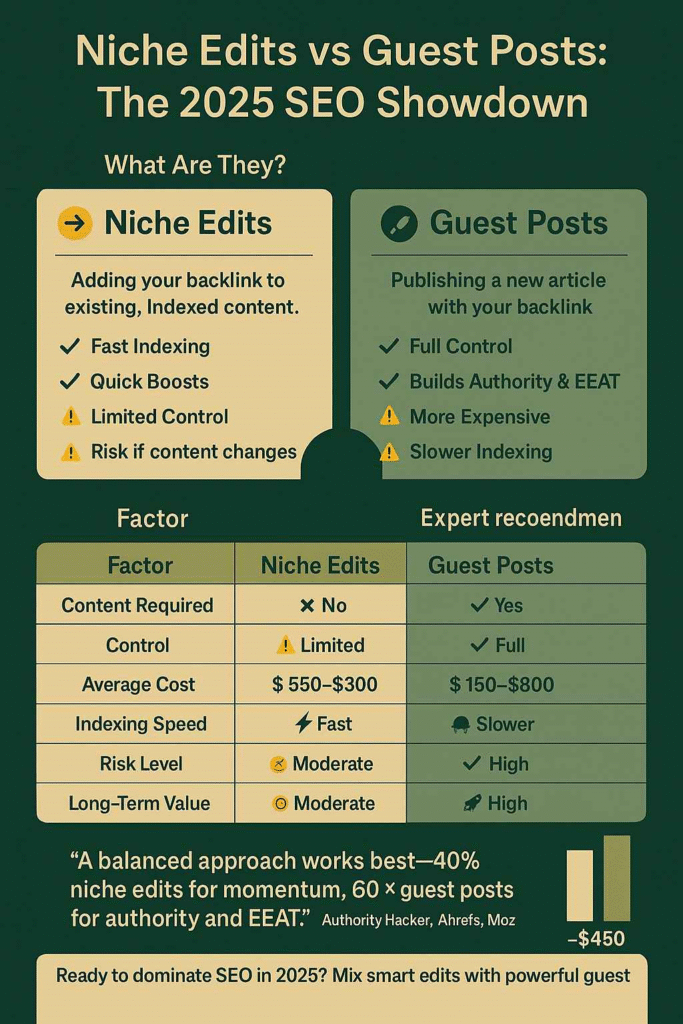
| Factor | Niche Edits | Guest Posts |
| Content Required | ❌ No | ✅ Yes |
| Content Control | ❌ Limited | ✅ Full |
| Average Cost | 💲 $50–$300 | 💰 $150–$800 |
| Link Placement Flexibility | ⚠️ Low | ✅ High |
| Indexing Speed | ⚡ Fast | 🐢 Slower |
| Anchor Text Control | 🎯 Limited | 🎯 Full |
| Risk Level | ⚠️ Medium | ✅ Low |
| Brand Exposure | ❌ Low | ✅ High |
| Long-Term SEO Value | 🔁 Moderate | 🚀 High |
Which One Builds More Link Equity in 2025?
Guest posts usually come out on top when it comes to long-term link equity. Why?
- They’re placed within original, relevant content
- You control the anchor and surrounding text
- A byline adds credibility to the page and the link
Niche edits, on the other hand, are faster and cheaper—but rely on someone else’s editorial quality. If the page goes down or gets rewritten, your link could take a hit.
📊 Semrush 2025 Study: Guest posts on DR70+ sites led to a 33% greater keyword boost than niche edits after four months.
How Do They Affect Your Link Profile? 📈
When analyzing Niche Edits vs Guest Posts for maintaining a natural link profile, balance is key.
Guest Posts Help With:
- New, diverse referring domains
- Naturally branded anchor text
- Trust signals via author bios and schema markup
Niche Edits Help With:
- Link volume growth
- Affordable scaling
- Fast anchor targeting
But overusing niche edits can:
- Over-optimize anchor text
- Create context mismatches
- Risk flagging by Google if links are too repetitive
👉 The best SEOs mix both to maintain a healthy, natural link profile.
Want to optimize your link strategy further? Read our bounce rate vs. edit rate article—it’ll help you understand how links affect behavior metrics.
Cost Comparison 💰
Budget also plays a major role when choosing between Niche Edits vs Guest Posts.
Niche Edits
- Range: $50–$500
- Average: ~$250
- Best for: Affiliate sites, budget projects, volume
Guest Posts
- Range: $150–$800+
- Average: ~$450
- Best for: SaaS, eCommerce, agencies focused on authority
📊 Editorial.Link (2025): Campaigns spending 60%+ of their link budget on guest posts saw a 42% better ranking improvement than those relying mostly on edits.
Which Is Safer After Google’s Link Spam Updates?
✅ Guest posts are considered safer under Google’s 2024–2025 guidelines.
✅ Checklist for Guest Post Compliance:
- Topic matches host site
- Unique, informative content
- Clear author attribution
- Minimal self-promo
⚠️ Avoid These Red Flags:
- AI-spun content
- Keyword-stuffed anchors
- Mass niche edits on shady domains
In light of recent algorithm changes, Niche Edits vs Guest Posts safety has become a top concern for SEOs
When Should You Use Niche Edits vs Guest Posts?
Use this quick reference to decide which works best in different Niche Edits vs Guest Posts scenarios.
| Situation | Best Choice | Why |
| Tight budget | Niche Edits | Quick results, low cost |
| Long-term SEO focus | Guest Posts | Builds trust + lasting value |
| Affiliate site growth | Niche Edits | Fast anchor-rich links |
| SEO agency client work | Guest Posts | More transparency + reporting |
| SaaS/product launches | Guest Posts | Control over narrative and link |
💡 Pro Tip: Kick off with niche edits for speed, then bring in guest posts to build up authority.
What Do Experts Recommend in 2025?
Most SEO experts agree: a hybrid approach works best.
According to Authority Hacker, Ahrefs, Moz and Editorial.Link:
- 40% niche edits for link volume and momentum
- 60% guest posts for authority and EEAT
This combo helps you:
- Move fast
- Stay compliant
- Maximize ROI
- Scale smarter
📊 WebFX 2025 Report: Blended link strategies outperformed single-tactic campaigns by 47% in keyword growth across 400+ client sites.
Interested in trying something new? Don’t miss our guide on broken link building—a reliable, white-hat way to earn backlinks by replacing dead links with your content.
What is the difference between niche edits and guest posts in SEO?
Niche edits are backlinks inserted into existing, indexed content, while guest posts involve publishing a new article on another website with your link included. Niche edits are faster and cheaper, while guest posts offer more control, authority, and long-term SEO value. Both are effective when used strategically.
Which is more effective for SEO in 2025—Niche Edits vs Guest Posts?
Guest posts are generally more effective for long-term SEO in 2025, especially after Google’s link spam updates. They offer better content relevance, EEAT signals, and brand exposure. However, niche edits are excellent for quick wins, budget campaigns, and anchor text targeting. A blended approach delivers the best results.
Are niche edits safe to use after Google’s 2024–2025 updates?
Yes, but only if you use white-hat niche edits—manual outreach to relevant, high-quality sites. Avoid mass insertions on low-quality domains, keyword-stuffing, or irrelevant placements, as these tactics are likely to be flagged by Google’s SpamBrain AI.
How much do guest posts and niche edits cost in 2025?
Niche edits typically cost between $50–$500, depending on domain authority. Guest posts range from $150–$800+, especially on high-DR or niche-specific sites. Guest posts are more expensive but offer stronger SEO and branding benefits.
Should I use both guest posts and niche edits in my link-building strategy?
Absolutely. Most SEO experts recommend a hybrid approach—use niche edits to build link volume and speed up results, and guest posts to strengthen authority, EEAT, and trust. This balanced strategy ensures a natural link profile and better long-term rankings.
Final Take: Which Link-Building Strategy Wins in 2025?
🎯 Go with niche edits if:
- You’re working with a small budget
- You want quick results
- You need to target specific keywords fast
🚀 Choose guest posts if:
- You’re focused on long-term SEO and branding
- You run a SaaS, agency, or high-ticket service
- You want to improve EEAT in competitive niches
🏆 Best Play: Use both—just be strategic.
Start with edits to build momentum, then scale with guest posts to earn trust and authority.
🚀 Ready to dominate 2025 with smart links? Start with budget-friendly edits, scale with high-authority guest posts, and watch your rankings grow.
👉 Explore our SEO packages or get in touch with our team to plan your next move.